Sit it.
Understand it.
Sit it again.
17 full LNAT practice papers online, £39.99. Paper 1 free, no sign-up.
Twelve passages, forty-two questions, ninety-five minutes on a clock you cannot pause — then one essay from three in forty minutes, with no way back to Section A. The same shape as the test you will sit, in a screen built to match it.
- 12
- passages
- 42
- questions
- 95
- min, Section A
- 40
- min, one essay
What you get for a wrong answer
Every wrong option carries the words that kill it.
Not a paraphrase, and not a restatement of why the key is the key. The sentence from the passage that rules the option out, quoted. Here is a real question from Paper 3 with one of its three disqualifiers.
The question
What comes closest to the meaning of ‘notice’ as it is used in these decisions?
- A.the rule’s having been entered in the public register
- B.the rule’s being ‘there to be found’ by a person so placed
- C.the rule’s being findable and his having actually gone looking
- D.the person’s ‘having been told’ of the rule
Why D fails
Paragraph 6 names and rejects exactly this: the word ‘is not being used in its everyday sense of having been told’. True of the ordinary word, not of the word in these decisions.
The move to take away
When a writer says a word is not being used in its everyday sense, the everyday sense becomes the trap and the technical gloss becomes the answer.
Every wrong option, every paper · each disqualifier quoting its own passage
What you get when the clock stops
A score tells you how many you got wrong. The results page tells you why.
Your raw score
Out of 42, the way the test reports it. No scaled marks, no percentile, no claim about what a university will do with it.
Where your wrong answers came from
Every wrong option in every paper belongs to one of six trap families: Strength & Scope, Relevance, Half-Right, Attribution, Reversal, Wording Camouflage. The families were developed from recurring distinctions highlighted in official LNAT guidance and its published answer rationales. Your results page counts your errors by family, so you can see the one habit that is costing you most.
Every question, reviewed
For each of the 42 questions: the sentence that rules out each wrong option, why the key is the key, and the move to take away, the one transferable reading habit the question was testing. Then sit the paper again when you are ready.
Measured against the published format
We don’t compare ourselves to other books. We compare ourselves to the test.
| Official LNAT | This site | Typical prep material | |
|---|---|---|---|
| Passages per paper | 12 | 12 | often 4–8 |
| Questions per paper | 42 | 42 | varies |
| Section A time | 95 min | 95 min | often untimed |
| Section B essay | 40 min, one of three | 40 min, one of three | often absent |
| Passage length | 410–726 words | 444–743 words | often shorter |
| Sentence length | 19–46 words a sentence on average | 19–35 words a sentence on average | — |
| Main-point questions | 8–11 a paper | 8–10 a paper | varies |
| Locate-and-retrieve questions | 10–18 a paper | 16–18 a paper | varies |
| Word-in-context questions | 3–6 a paper | 3–5 a paper | varies |
| Tone questions | 2–4 a paper | 2–4 a paper | varies |
| Argument-structure questions | 2–5 a paper | 2–4 a paper | varies |
| Cross-passage questions | 4–6 a paper | 4–6 a paper | varies |
| Negatively phrased questions | 7–12 a paper | 7–12 a paper | few or none |
| Answer-key spread | no letter more than 33% of keys | no letter more than 33% of keys on any paper | — |
| Passages with more than one voice | present in the published tests | two a paper, four extracts each | rare |
| Period prose | present in the published tests | two a paper: an Edwardian address, an interwar essay | modern only |
| Wrong-answer diagnosis | commentary explains each wrong option | every wrong option tagged to one of six trap families, counted on your results page | none |
| Section B titles | three a paper, on ethics, politics, education, science and society | three a paper, on the same range of subjects | often absent |
| Delivery | on-screen, split pane | on-screen, split pane | PDF or print |
| Flag for review | yes | yes | — |
| Colour schemes | 11 | 11 | — |
The right-hand column describes prep material as a category, not any named product. Official figures are from the LNAT Consortium’s published test format and its 2010 practice papers.
How we check our own questions
A question you can answer without reading the passage is a broken question.
Every question is solved twice by independent readers who never saw our answer key, and then a third time with the passage taken away. If a reader who has never seen the passage can still pick the key, the item is testing something other than reading, and we rebuild it.
The LNAT’s own published practice papers can be answered about 62% of the time with the passage withheld — a high bar to match, because it means the questions really do depend on the reading. Our measured papers sit at the same level. That is construct alignment with the published test, not a claim about your score.
Every disagreement between our two readers is written up and settled before a paper ships, and there is a button on every explanation to report a question you think is wrong. We read them.
Section B, as it is sat
Three titles, forty minutes, and no way back.
When Section A closes, three essay titles appear and a forty-minute clock starts. You choose one and write in the box, as on the day; the titles are written to the published format, one to each paper, and Section A cannot be reopened once you are in Section B.
Your essay is saved with your attempt and shown back to you with its word count, so you can read it cold the next day and compare it with your next one. Written feedback on Section B is not part of this release, and we do not score essays or compare them with any university’s marking.
Every passage and question on this site is original material written to the published LNAT format. We are not affiliated with the LNAT Consortium.
New to the test?
If the LNAT is new to you, read the book first.
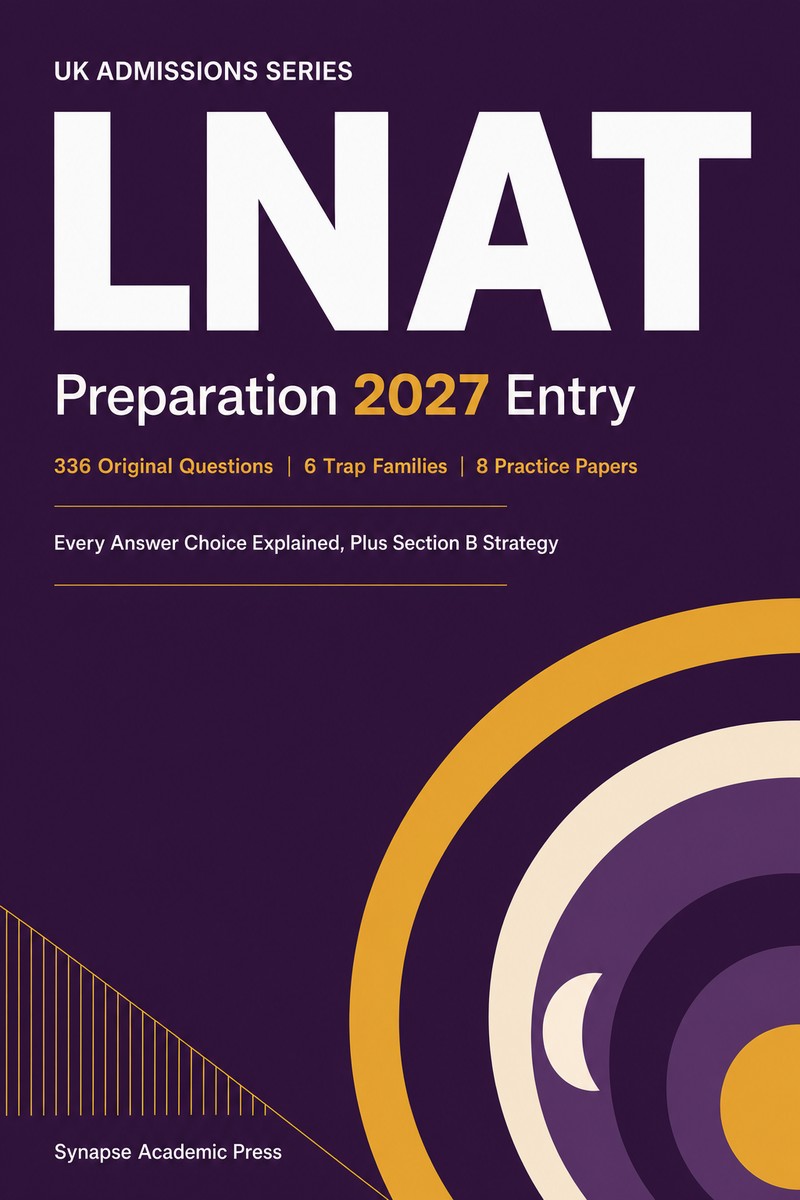
These papers are practice. LNAT Preparation 2027 Entry, from the same press, is the teaching: what each question family is really asking, the six trap families and how to spot them, how to read a passage against the clock, and how to plan the essay. Read it, sit Paper 1 here free, then use the papers to practise what it taught.
Questions people ask
LNAT practice papers, in plain answers.
- Is there a free LNAT practice test?
- Yes. Paper 1 is completely free: the whole timed Section A (12 passages, 42 questions, 95 minutes), every explanation, your error profile by trap family, and the 40-minute Section B essay. No account, card or email.
- How many LNAT practice papers are there?
- 17 full-length papers, 714 original questions. Paper 1 is free; the other 16 unlock together for £39.99, one payment, no subscription.
- Is the format the same as the real LNAT?
- Each paper follows the LNAT Consortium's published test format: 12 passages, 42 questions and 95 minutes for Section A, then one essay from three titles in 40 minutes, sat on screen in a split pane with a flag-for-review control and a clock that cannot be paused. Passage length, question mix, negative-stem rate and answer-key spread are measured against the three published practice tests and sit inside their range.
- Are these real LNAT past papers?
- No. Every passage and question is original practice material written to the published LNAT format. The LNAT Consortium publishes its own practice tests, which are the best first thing to sit; these papers are for the practice that comes after them.
- What do I get after finishing a paper?
- Your raw score out of 42; a breakdown of your wrong answers by six trap families (Strength & Scope, Relevance, Half-Right, Attribution, Reversal, Wording Camouflage); and, for every question, the sentence from the passage that rules out each wrong option, why the key is the key, and the reading habit the question was testing.
- Is Section B marked?
- Your essay is timed, saved and shown back to you with its word count so you can review it. Written feedback on Section B is not part of this release, and no essay is scored or compared with any university's marking.
- How are the questions checked?
- Every question is solved by two independent readers who never saw the answer key, then a third time with the passage withheld to confirm it cannot be answered from general knowledge. Every disagreement is adjudicated in writing before a paper is released.
- I am new to the LNAT. Where should I start?
- Read the book first. LNAT Preparation 2027 Entry (Synapse Academic Press, on Amazon) teaches the test from the beginning: what each question family is asking, the six trap families, and how to read a passage under the clock. Then sit Paper 1 here free, and use the papers to practise what the book taught.
- Is this site affiliated with the LNAT Consortium?
- No. Not affiliated with, endorsed by or connected to the LNAT Consortium, LNAT Consortium Ltd or Pearson VUE. LNAT is a registered trade mark of LNAT Consortium Ltd, used here only to identify the test.
Paper 1
Free
The whole paper. Timed Section A, all 42 explanations, your error profile, and the Section B essay. No account, no card, no email.
Start now →Papers 2–17
£39.99
One payment, all sixteen, no subscription. 714 questions across the seventeen papers, each with its own essay section. Sign in with Google or Microsoft to buy; Paper 1 stays free either way.
Unlock 17 →